

April 2026 Tax News

WE ARE HIRING!

Discover career opportunities with DPC

Welcome to the April 2026 edition of Tax E-News.

Please contact us if you wish to discuss any matters in more detail.

MAKING TAX DIGITAL FOR INCOME TAX – GO LIVE!

WHAT ELSE IS CHANGING IN THE 2026/27 TAX YEAR?

DIVIDENDS: HMRC ARE WATCHING

VAT ON PUBLIC ELECTRIC VEHICLE CHARGING

MAKING TAX DIGITAL FOR INCOME TAX – GO LIVE!

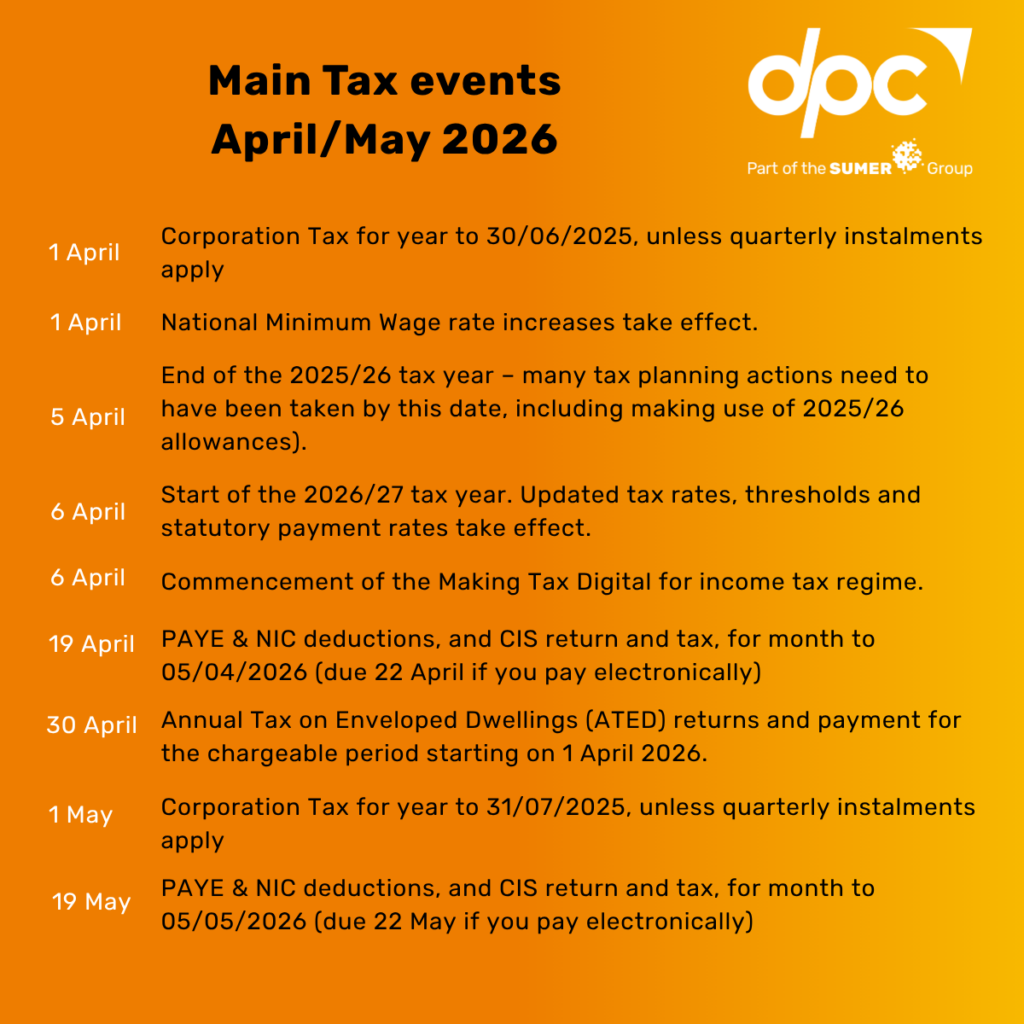
The commencement of Making Tax Digital (MTD) for income tax goes live on the 6th of April.

This is the new 2026/27 tax year regime for self-employed individuals and landlords if they have business and/or property income (i.e. total takings, not net profits) of more than £50,000 per annum. MTD requires digital record-keeping and quarterly updates to HMRC, with the first such update due by 7 August 2026.

The final MTD Regulations were laid before Parliament on 24 March 2026.

If you are one of the 860,000 individuals moving into the new regime, HMRC are also keen to stress that a normal annual tax return will still be required for the 2025/26 tax year. This means that in addition to providing HMRC with quarterly updates during the year to 5 April 2027, your annual 2025/26 tax return will still need to be filed by 31 January 2027.

We have been assisting our clients with the move to MTD. Please do reach out if we are not already planning your transition into this new digital regime.


WHAT ELSE IS CHANGING IN THE 2026/27 TAX YEAR?

It can be hard to keep track of tax changes, with the start of a new tax year often bringing new rates, allowances and other legislative changes. To make things easier, here is a list of the key tax changes that will take effect from April 2026.

INCOME TAX

In 2026/27 income tax rates, thresholds and bands generally remain at their 2025/26 levels. One key change from 6 April 2026 is the rate of income tax that applies to dividend income. For dividends falling within a taxpayer’s £37,700 basic rate band, the rate increases to 10.75% (from 8.75%). For dividends in the higher rate band (£37,701 – £125,140), the rate increases to 35.75% (from 33.75%). The rate of income tax on dividends above the additional rate threshold (£125,140) remains unchanged at 39.35%.

CORPORATION TAX

The rate of tax (known as the ‘s455’ tax charge) on loans to ‘participators’ (broadly shareholders) in ‘close companies’ (broadly companies controlled by 5 or fewer participators), is set according to the dividend upper rate. This means that the tax charge on loans that remain unpaid 9 months and 1 day after the accounting period end will increase to 35.75% for loans and advances made on or after 6 April 2026.

Another key corporation tax change is the new penalty amounts applicable to late-filed corporation tax returns. For returns with a due date that is on or after 1 April 2026, the penalties are:

The CGT rates applicable to gains qualifying for both Business Asset Disposal Relief (BADR) and Investors’ Relief (IR) are set to increase again to 18% on 6 April 2026. The rates previously increased to 14% (from 10%) on 6 April 2025.

VAT

From 1 April 2026, a new relief will exclude most donations of business goods to charities from the deemed-supply VAT rules.

DIVIDENDS: HMRC ARE WATCHING!

NEW CONSULTATION ON REPORTING COMPANY PAYMENTS TO PARTICIPATORS

Returning to corporation tax, a new consultation, ‘Reporting company payments to participators’ has been published, inviting views on proposals to introduce new requirements to report transactions between close companies and their participators to HMRC.  

The government believes that the risk of error and tax evasion is greatest in close companies, where the legal distinction between the company and its participators is sometimes misunderstood, and the level of control can enable tax avoidance. HMRC’s investigations have concluded that they are not receiving the full picture on how close companies interact with their participators.

Under the proposals, close companies will be required to provide HMRC with detailed information on transactions between the company and its participators, including:

  • Payments, via cash, bank transfer or otherwise.
  • Loan repayments and write offs.
  • Sales of assets to the company.
  • Purchases of assets from the company.
  • Dividends or other distributions.
  • Any other transfer of value from the company to the participator.

Salary and wage payments would not need to be reported under any new mechanism introduced, as they are already captured as part of PAYE reporting.

NEW DIVIDEND DATA BEING COLLECTED VIA 2025/26 SELF ASSESSMENTS

Finance Act 2024 introduced powers to enable the collection of additional data on income tax self-assessment and allowed for HMRC to specify the particular information required.

HMRC now have powers to collect additional information from company directors and, as a result, the 2025/26 self-assessment tax returns will require the following information:

  • If the taxpayer was a director of a company;
  • If the company was a close company;
  • The company’s name and registration number;
  • Dividends the taxpayer received from the close company during the tax year; and
  • The highest percentage shareholding that the taxpayer held during the tax year.


Combined with the above consultation and more detailed disclosure requirements for company accounts, we can see that HMRC will have increased access to information on dividends and director transactions . It will pay to make sure that dividend procedures are tight, lawful and compliant. Please do contact us if we can assist in this regard.

VAT ON PUBLIC ELECTRIC VEHICLE CHARGING

In a recent VAT case (Charge My Street Ltd v HMRC [2026] TC09802), the First Tier Tribunal found that electric vehicle charging supplied at public charging stations qualified for a 5% reduced rate VAT charge. This ruling contradicts HMRC’s long-held policy that electric vehicle charging at public charging stations is subject to a standard 20% rate of VAT.

Charge My Street Ltd (CMS) supplied electric vehicle charging at charging stations in public places in the North of England, which were installed and operated by CMS. CMS considered that VAT was due on the supplies at the reduced rate of 5% which applies to supplies of fuel and power for (or deemed for) domestic use.

VAT legislation allows ‘domestic’ supplies of fuel and power to be reduced-rated at 5%. ‘De minimis’ supplies of electricity (below 1,000 kWh per month) are classed as domestic supplies.

The Tribunal found that when supplies were made to individual customers, they were below 1,000 kWh per month and therefore qualified for the 5% reduced-rating.

This ruling effectively removes the VAT disparity between reduced-rated electricity used to charge vehicles at home and the standard-rated electricity used to charge vehicles and public charging stations. Does this mean we can expect to see a reduction in price at public charging stations?

Unfortunately, not, or not yet. The Tribunal finding does not carry force of law and it is expected that HMRC will appeal. We will watch the CMS case progress with interest however. This case also demonstrates how complicated VAT can be and if you have any doubt about the VAT rate you should be applying to your products and services, please do get in touch.

SEARCH

Hmrc Enquiries Support & Protection

TAX PLANNING

SPECIALISMS